
The Rover and the Vine: Autonomous Fungicide Application Between the Rows
Fungicide application is one of the most important and time-sensitive elements of any vineyard management programme. The UK's maritime climate, with its warm, humid summers and unpredictable rainfall, creates conditions that favour the rapid development and spread of fungal diseases. Missing a treatment window or applying the product inconsistently can have consequences that run all the way through to harvest quality and yield. Autonomous ground rovers are changing how vineyard managers approach this work, making programmes more consistent, more precise and considerably less demanding on the people running them.
Why does fungicide application in vineyards require a ground rover rather than a drone?
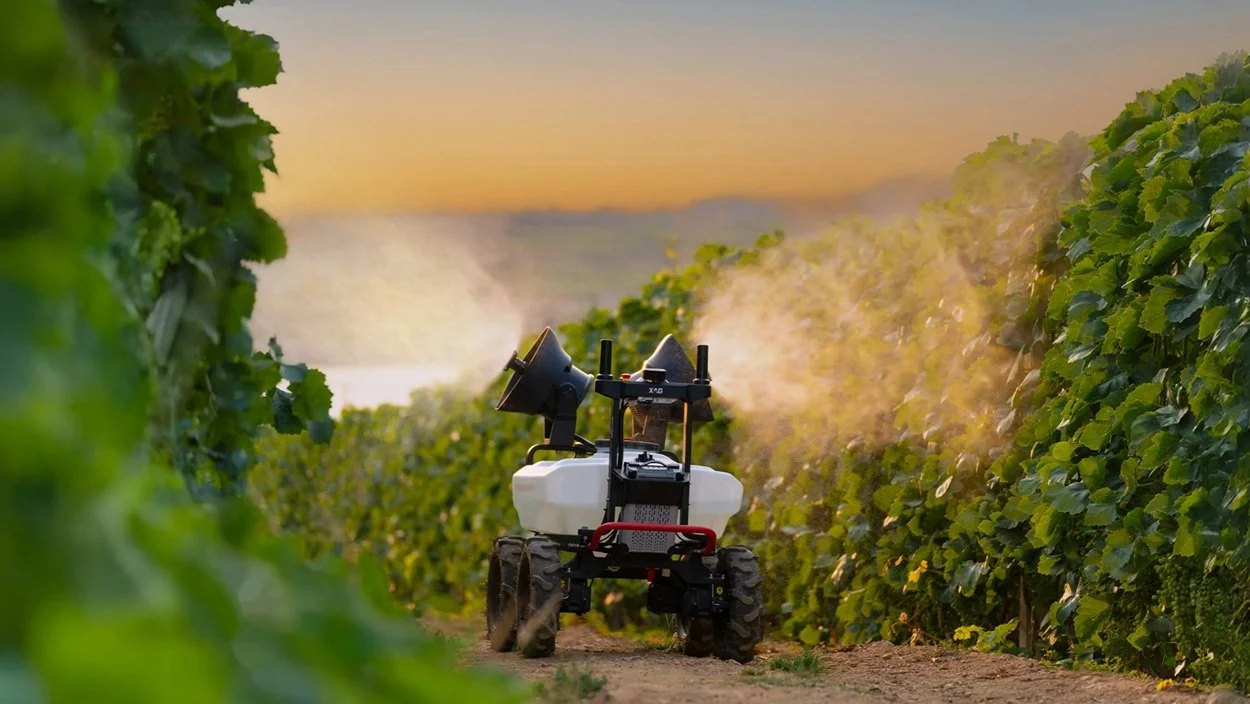
Fungicides cannot currently be applied via drone in the UK. All fungicide treatments must be applied from the ground, making ground-based application a significant practical consideration for vineyard managers. The XAG R100 agricultural rover is designed specifically for this kind of close-row work, navigating the inter-row space autonomously and delivering product consistently on every pass.
For vineyards running regular fungicide programmes during the downy mildew and powdery mildew risk period, which typically runs from late spring through to veraison, having a reliable, autonomous delivery method makes a meaningful difference to how manageable the programme is in practice.
How does the XAG R100 rover navigate vineyard rows?
The rover learns the route on its first pass, either by being driven manually through the rows or by mapping the area from satellite imagery. From that point, it repeats the route autonomously, maintaining its position accurately and adjusting its pace to suit the terrain as it goes. The operator monitors progress remotely rather than walking alongside the machine, which means a single person can oversee a treatment programme that would otherwise require a full team with knapsack sprayers or a tractor and air-blast equipment.
For vineyards with long rows or complex layouts, the rover's ability to work independently through the site without constant supervision is a genuine operational advantage.
What fungal diseases does rover-based application help to manage in UK vineyards?
Downy mildew is the primary concern for most UK vineyard managers through the growing season. It spreads rapidly in warm, wet conditions and requires consistent fungicide coverage throughout the canopy, including the bunch zone, to manage effectively. Powdery mildew is a secondary but persistent pressure, particularly in warmer, drier periods, and botrytis becomes an increasing concern as the season progresses towards harvest.
All three diseases require thorough canopy coverage to manage effectively, and the rover's JetSprayer system is well suited to delivering that. The directed airflow drives product into the canopy from the side, reaching both surfaces of the foliage and penetrating to the bunch zone where botrytis risk is highest.
How does the rover achieve canopy penetration in a mature vineyard?
By midsummer, a well-managed vineyard canopy is dense, with multiple layers of foliage between the outer surface and the bunch zone. Coating the outer leaves is not sufficient; effective disease management requires the product to reach the inner parts of the canopy where air circulation is limited, and humidity tends to be highest.
The rover addresses this through directed airflow from its JetSprayer nozzles, which push the spray through the foliage rather than simply depositing it on the surface. The result is coverage that reaches both sides of the leaves and penetrates to the developing bunches, which is where thorough protection matters most in the weeks before veraison.
Can the agricultural rover work alongside the drone in a vineyard programme?
Yes, and many vineyard operations benefit from using both. The rover handles the fungicide programme throughout the growing season, while the XAG P100 Pro agricultural drone can be deployed for foliar nutrition applications, where aerial delivery offers advantages in canopy penetration and coverage speed. Boron applications ahead of flowering and magnesium or calcium nutrition through the growing season are well suited to drone delivery, freeing the rover to focus on the chemical treatment programme.
This dual approach gives vineyard managers greater flexibility in scheduling and executing their programmes, and it means the most time-critical treatments on either platform don't have to wait for the other to finish.
Which vineyard layouts suit the XAG R100 rover best?
The R100 is well suited to standard vineyard row spacings and handles the gentle to moderate gradients found across most English vineyard sites. Its narrow profile allows it to work comfortably between rows without damaging vine trunks or disturbing training wires, and its autonomous navigation handles the variation in row length and terrain that is common in real-world vineyard layouts.
For larger vineyard operations or those with longer rows and more demanding terrain, the XAG R200 rover offers greater tank capacity and six-wheel traction for more challenging ground conditions. The QuadRotor team can advise on which platform best suits your site; get in touch to discuss your vineyard layout and the treatment programme you're running.