
Summer Renovation Without Disruption: Drone Overseeding on Busy Golf Courses
Summer is the worst possible time to close a golf course for renovation work, yet it's often when the turf needs the most attention. Heavy play through the spring and early summer leaves its mark; tees show wear around the mat areas, approaches thin out under repeated traffic, and even well-managed greens can develop bare patches or areas of reduced density that affect the quality of the playing surface. The challenge for greenkeepers is how to address these problems without disrupting the playing schedule or putting machinery onto surfaces that are already under pressure.
Why is summer overseeding on golf courses so difficult with conventional methods?
Traditional overseeding involves either a dedicated seeder that scarifies and introduces seed directly into the sward, or broadcast spreading from a tractor or ride-on unit. Both approaches have their place in the annual renovation calendar but both also carry significant limitations during the peak playing season.
Mechanical seeders require the surface to be taken out of play for a period before and after treatment, which is rarely acceptable on high-traffic holes during the summer months. Tractor- or ride-on-spreaders avoid the scarification issue but still put wheel weight on turf that may already be stressed, and the logistics of working around the playing schedule on a busy course add complexity to what should be a straightforward operation.
For greenkeepers managing courses with limited closure windows and a membership that expects consistent surface quality throughout the season, these constraints are a genuine practical problem.
How does drone overseeding solve the disruption problem on golf courses?
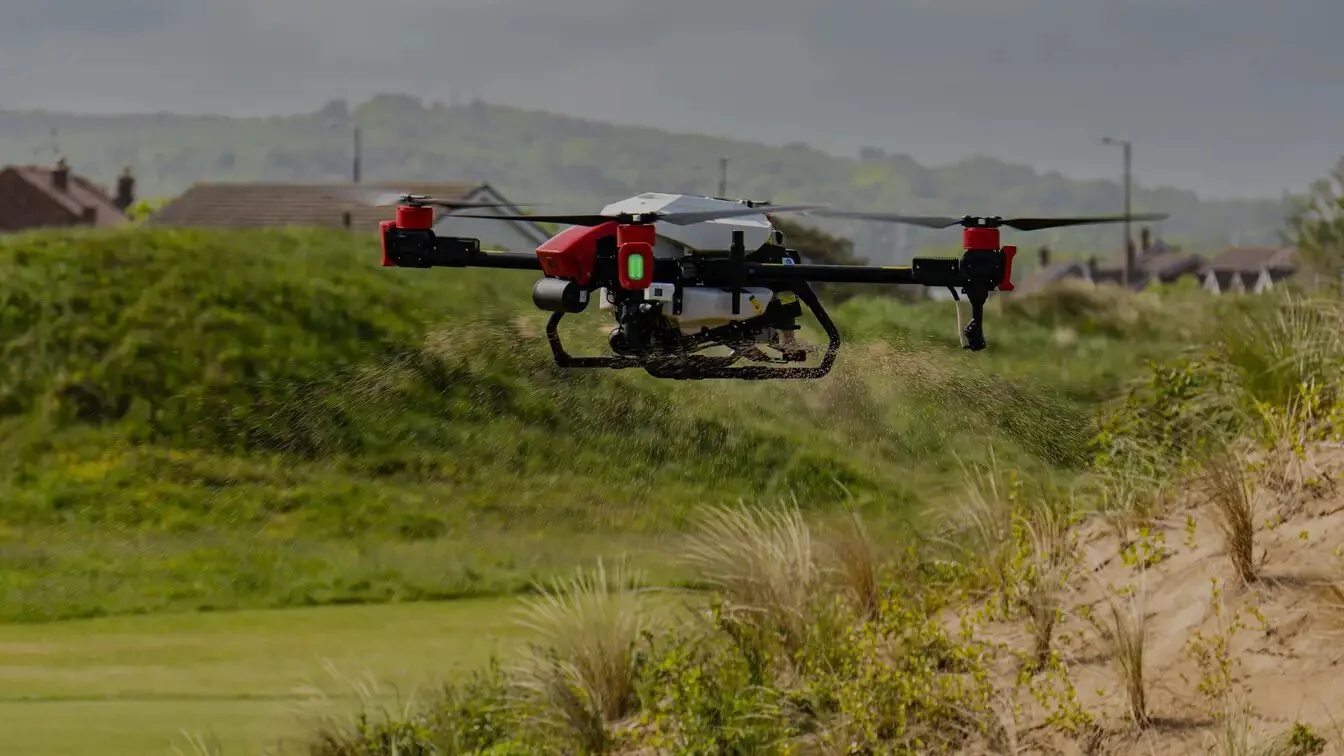
The XAG P100 Pro agricultural drone can broadcast grass seed across greens, tees, approaches and fairways without putting any weight on the surface. There are no tyre marks, no compaction and no disruption to the playing surface that would require the area to be taken out of play. The drone follows a precise route across each area, distributing seed evenly and consistently from edge to edge, and the operation can be completed in a fraction of the time it would take for ground-based spreading across a full eighteen-hole course.
Crucially, the drone can operate early in the morning before play begins or in the evening after the course closes, fitting the operation into the existing windows in the playing schedule rather than requiring additional closure time. For a course running a full summer diary of competitions and visitor rounds, that flexibility is genuinely valuable.
Which areas of a golf course benefit most from drone overseeding in summer?
Tees are typically the first area to show wear during a busy summer season, particularly around the mat and peg positions on courses that don't rotate their tee markers frequently enough. A drone overseeding pass can introduce fresh seed into thin areas without the need to take the tee out of play, supporting recovery during the season rather than waiting for the autumn renovation programme.
Approaches are similarly vulnerable to summer wear, particularly on courses with heavy trolley and buggy traffic. Greens benefit from overseeding where localised bare patches or areas of reduced density have developed, and the drone's ability to work precisely across the green surface without mechanical contact makes it well suited to this application.
Fairways can also be included in a summer drone overseeding programme, particularly on courses where drought stress or disease has created thin or bare areas that need to be addressed before the condition deteriorates further.
What grass seed mixes are suitable for drone overseeding on golf courses?
The drone handles a range of fine turf seed mixes suitable for golf course use, including bent and fescue blends for greens and tees and hardwearing ryegrass-based mixes for approaches and fairways. The specific mix should be chosen to match the existing sward composition and the performance characteristics the greenkeeper is working towards; this decision is best made in consultation with the course's agronomist or seed supplier.
Seed size and flow characteristics vary between species, and the drone's spreading settings are adjusted accordingly. The QuadRotor team can advise on which seed types work well with the XAG P100 Pro's spreading system and help plan the application rate for the treated areas.
Can chemical turf treatments be combined with drone overseeding on golf courses?
Not via the drone. Fungicides, herbicides and other chemical treatments for golf course turf must be applied from the ground under current UK rules. Where disease management or weed control forms part of the summer maintenance programme alongside overseeding, those applications need to be delivered by conventional ground-based equipment and scheduled separately from the drone operation.
The drone's role on the golf course is focused on seed and granular inputs, biostimulant applications and foliar nutrition, where aerial delivery offers clear advantages over ground-based methods in terms of surface impact and operational flexibility.
How do I arrange drone overseeding for my golf course this summer?
Summer renovation programmes benefit from early planning. If you're thinking about drone overseeding for your course, the time to get in touch is before the season peaks, rather than once the wear is well established. The QuadRotor team can discuss which areas of your course would benefit most from drone treatment, how the operation would fit around your playing schedule and what the logistics of a visit would look like. Get in touch via enquiries@quadrotor.co.uk to start the conversation.