
The Productivity Equation: Comparing Coverage Rates for Drones, Rovers and Traditional Equipment
One of the most common questions that comes up when farmers, growers and land managers first explore drone and rover technology is a straightforward one: how does it compare to what I'm already using? It's a fair question and one that deserves a considered answer. The comparison isn't always simple, because the situations in which drones and rovers are most useful are often precisely the ones where traditional equipment struggles. Understanding the differences in how each platform works and what it can realistically cover is a useful starting point.
How does an agricultural drone compare to a tractor boom sprayer for coverage?
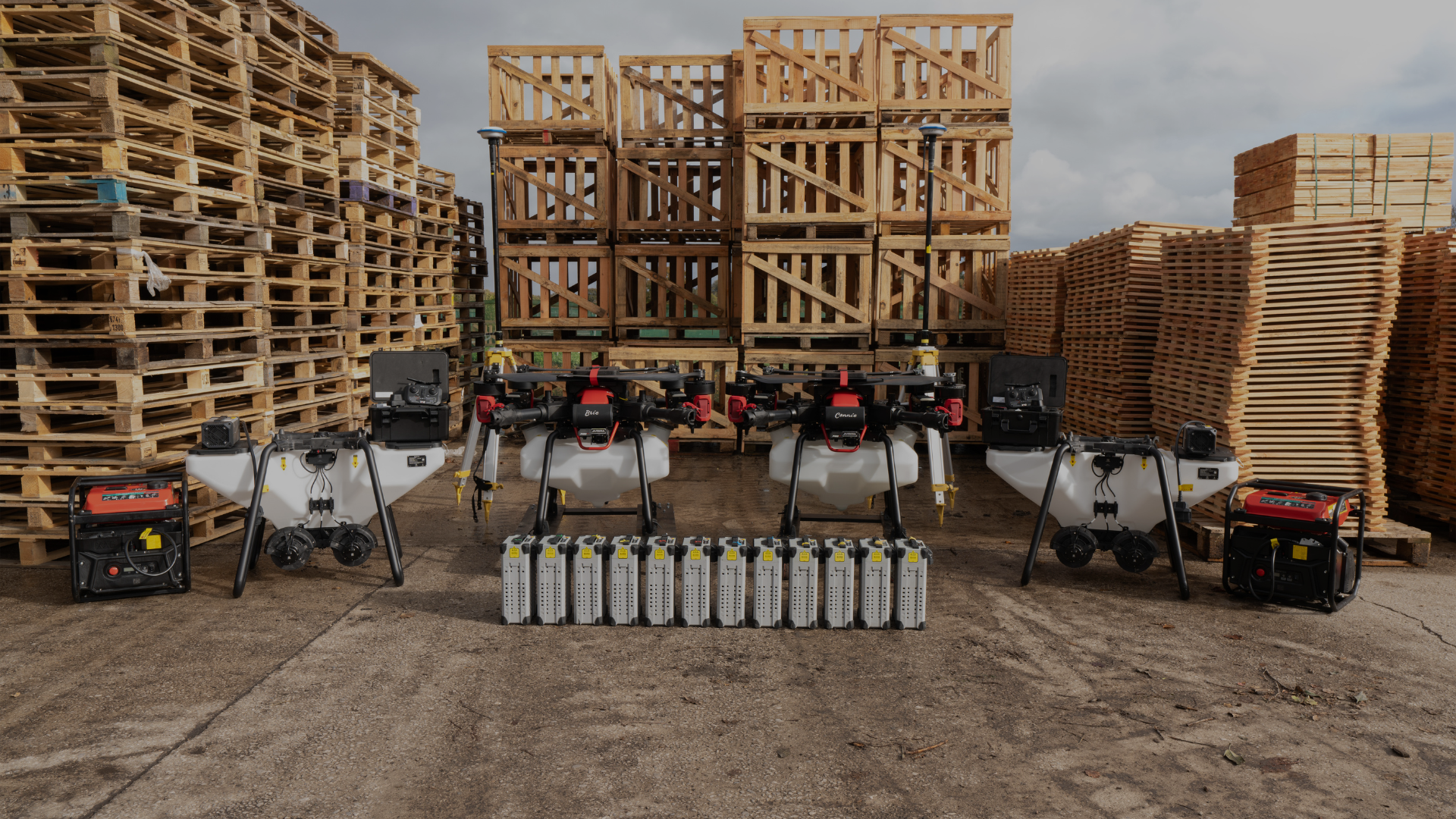
The XAG P100 Pro agricultural drone is designed for precision rather than pure speed across large open acreages. A modern tractor with a wide boom sprayer covers broadacre fields at a rate that a single drone cannot match on a straight hectares-per-hour comparison. For straightforward flat-field spraying of approved products across large uniform blocks, the boom sprayer remains an efficient tool.
The comparison shifts in situations where the boom sprayer cannot perform at its rated efficiency or at all. Waterlogged fields, steep terrain, irregular field shapes, crops at a growth stage where tractor damage is unacceptable, and sites where soil compaction is a concern all significantly reduce the effective output of ground-based equipment. In those situations, the drone's ability to operate regardless of ground conditions, without compaction risk and across any terrain the field presents, changes the comparison considerably.
For foliar nutrition, biostimulants and plant growth regulators applied at relatively low volumes per hectare, the drone's combination of precision, flexibility and ground independence makes it a genuinely competitive option even on sites where conventional equipment could theoretically access the field.
How does the coverage rate compare between the agricultural drone and conventional equipment for seeding?
For aerial seeding applications, including cover crops, grass mixes and wildflower establishment, the drone covers ground at a rate that compares favourably with many conventional broadcast spreading options, particularly on sites with access challenges or irregular boundaries. The ability to map the exact area to be treated and seed precisely to that boundary, without the overlap and waste that comes with conventional spreading on awkward sites, also improves the efficiency of the operation.
On large, straightforward arable fields with easy access, conventional pneumatic or centrifugal broadcasters mounted on a tractor can achieve higher output rates. The drone's advantage on seeding tasks comes from the same places as its spraying advantage: access, precision and the absence of ground disturbance.
How does the agricultural rover compare to tractor-mounted equipment in orchards and vineyards?
This comparison is more straightforward in some respects because the situations where the XAG agricultural rover is most relevant are often those where tractor-mounted equipment either cannot operate at all or operates at significantly reduced efficiency. High-density orchard rows, narrow vineyard inter-row spacings and enclosed glasshouse environments all represent settings where the rover's compact profile and autonomous navigation give it a clear practical advantage over conventional machinery.
In terms of output per hour, the rover operates at a pace suited to thorough canopy coverage rather than maximum ground speed. The comparison with a knapsack or hand lance operation is more relevant than a comparison with a large air-blast sprayer, and on that basis, the rover's consistent, autonomous coverage across a full treatment session compares very favourably with the output and quality achievable through manual methods.
Does the drone or rover reduce the total number of passes needed across a season?
Not necessarily in terms of the number of applications required; the treatment programme is determined by agronomic need rather than the delivery platform. Both platforms can complete each application more efficiently and with greater consistency than conventional methods in situations where they are most useful, reducing the time and resources required per pass rather than the number of passes.
For operations where labour availability is a constraint, the autonomous nature of rover operation in particular means that a treatment programme can be maintained without the same staffing demand that manual application requires. That has a real impact on how reliably the programme runs through the season, particularly during busy periods when competing demands on staff time are greatest.
What is the most useful way to compare drone and rover productivity with traditional methods?
Rather than looking at coverage rate in isolation, the most useful comparison takes into account the full picture: the quality and consistency of coverage achieved, the access and terrain constraints that affect each method, the soil and surface impact of the operation, the staffing required to run it and the reliability with which the programme can be maintained through the season.
On all of those measures, drone and rover technology offers genuine advantages in the settings it is designed for. The productivity equation isn't just about hectares per hour; it's about how effectively and consistently the work gets done across a full season on real-world land with all the variability that involves.
How do I work out whether drone or rover technology is sufficient for my operation?
The best way to understand the practical productivity of drone and rover technology on your specific site is to see it in action and discuss the details of your operation with the QuadRotor team. Every farm, orchard, vineyard and golf course is different, and the productivity comparison looks different depending on what you're currently doing, what constraints you're working within and what outcomes you're trying to achieve. Get in touch to arrange a conversation or a demonstration, and we'll help you work through the numbers in the context of your own situation.