
The "Air-Assisted" Advantage: Driving Nutrition into Dense Canopies
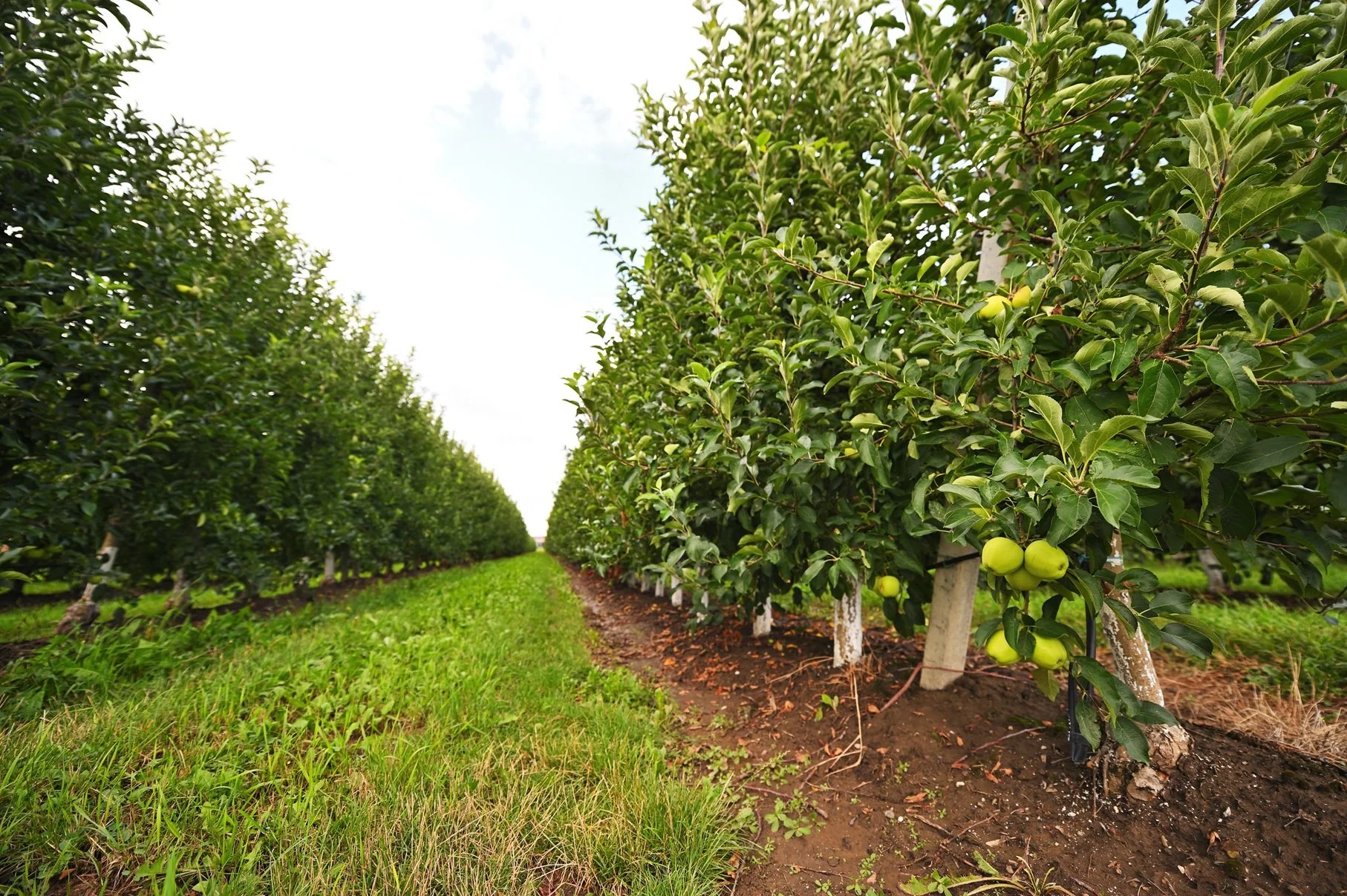
By the time May is in full swing, apple and pear trees across the UK's top-fruit regions are putting on growth at a rate that can feel almost visible from one day to the next. It's one of the most productive periods in the orchard calendar, and also one of the more challenging ones for anyone trying to get a foliar spray into the heart of a rapidly developing canopy. The outer leaf mass expands quickly, and what was an open, penetrable structure in early spring becomes progressively denser with each passing week. Getting nutrition (or indeed any foliar product) to where it's actually needed inside that canopy requires more than simply pointing a sprayer at the tree. QuadRotor's agricultural drone services leverage the aircraft's physics to solve that problem.
Why Does Canopy Penetration Matter for Foliar Nutrition?
A foliar spray that sits primarily on the outer surface of the canopy delivers most of its product to the leaves that need it least; the youngest, most recently expanded outer leaves that are already well-exposed to light and air movement. The nutrition that matters most for fruit development (calcium for cell structure, magnesium for photosynthesis, boron for fruit set and quality) needs to reach the inner canopy; the older leaves, the developing fruitlets tucked inside the branch structure, and the areas of the tree that are doing the most metabolic work at this stage of the season.
In a dense May canopy, getting product to those inner zones is the central challenge of foliar nutrition. It's not simply a question of volume; it's a question of where the product actually ends up.
What Is the "Air-Assisted" Effect and How Does a Drone Create It?
Air-assisted spraying is an established principle in orchard management; the idea that airflow directed into the canopy alongside spray droplets improves penetration and deposition on inner leaf surfaces far more effectively than droplets settling by gravity or gentle air movement alone. Conventional air-blast sprayers use a fan to generate this effect from the side of the row.
A drone creates a similar (and in some respects more effective) version of this from above. The rotors generate a powerful column of downward airflow directly beneath the aircraft; a consistent, controllable pressure that drives spray droplets down through the outer canopy and into the interior of the tree. As the drone travels along the row, that downwash effect moves progressively along the canopy, working product into the spaces between branches and onto the surfaces that a gravity-driven spray would struggle to reach.
Does the Downwash Effect Work on All Canopy Structures?
It works best on canopy structures with genuine internal space for airflow to work into; traditional bush apple forms, spindle systems, and the kind of semi-open canopy structures common in established UK orchards. Very high-density systems (e.g., some modern tall-spindle plantings) with extremely narrow inter-row spacing and a tight canopy architecture may present different dynamics; worth considering during the planning stage of any drone application programme.
For the majority of UK commercial orchards (particularly the older-established plantings across Kent, Herefordshire and Worcestershire, which make up a significant portion of the national top-fruit acreage), canopy structure is well suited to the downwash-assisted application approach.
How Does This Compare to Conventional Air-Blast Application?
Conventional air-blast sprayers are effective and widely used; this isn't an argument for replacing them wholesale. The comparison is more nuanced than that. Air-blast application works well in dry conditions on accessible ground with sufficient row width for the tractor to pass safely. Where drone applications offer a specific advantage is the combination of aerial delivery (no ground access required) with downwash penetration (inner-canopy coverage) and the precision of GPS-guided flight paths (consistent coverage without variation caused by tractor speed, operator fatigue or terrain).
In practical terms, many orchard managers find the strongest case for drone application in May is specifically around the windows (post-rain, on soft ground, during peak growth flush) when conventional equipment is either restricted by conditions or struggling to maintain the timing precision that effective nutrition and crop protection programmes require.
Can the Downwash Effect Be Controlled or Adjusted?
The intensity of the downwash is influenced by the drone's flight height above the canopy; flying closer to the canopy increases the pressure of the airflow reaching it, whilst a greater height reduces it. This parameter can be set during flight planning and adjusted between blocks or applications, depending on the canopy structure and the specific product being applied.
For orchard managers running mixed plantings with varying canopy densities across different blocks (a common situation in orchards developed or replanted across different eras), adjustability means a single operation can be optimised for each section of the site rather than applying a single fixed approach across the board.