
What are agricultural drones and how do they work?
Agricultural drones are specialised unmanned aerial vehicles engineered to automate key farming tasks, including mapping, crop scouting and liquid distribution. At QuadRotor, we supply autonomous aerial technology that integrates with global positioning networks to deliver precision management across UK farms. These systems operate entirely in the air to streamline data collection and organic crop care.
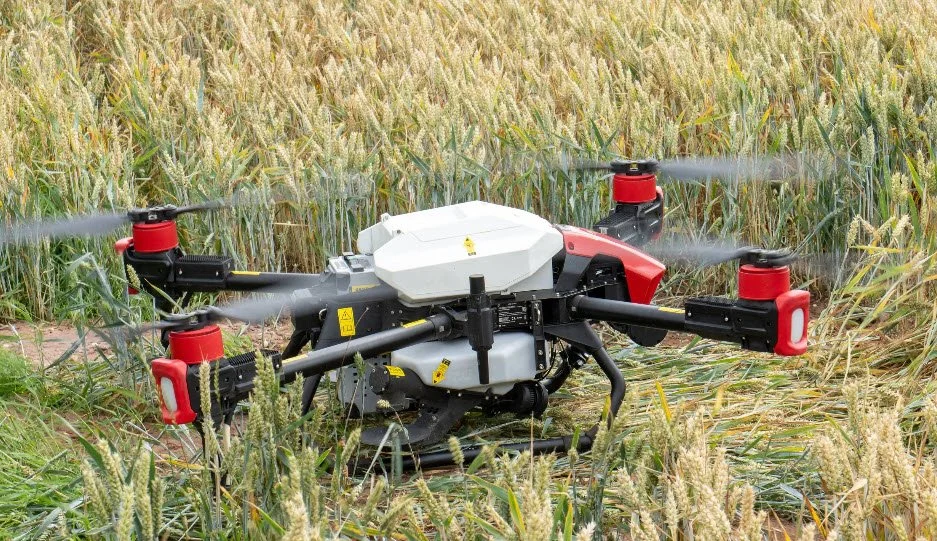
To understand how they work, the process begins with data acquisition. The drone flies over a target area using high-definition optical sensors to capture detailed imagery. The internal software compiles these images to create a highly accurate three-dimensional model of the land. Once this digital framework is established, the drone executes precise flight patterns to distribute inputs from above.
It is essential for growers to recognise the distinct operational boundaries between aerial drones and ground-based vehicles. While an aerial drone is used for high-speed scanning and the distribution of biological controls or specialised nutrients, it is legally restricted from applying standard crop chemicals. For tasks involving synthetic inputs, farmers utilise autonomous ground rovers that move between crop rows on wheels to ensure regulatory compliance.
Satellite Guidance: The aircraft utilises real-time kinematic positioning to navigate within centimetre-level accuracy.
Smart Payloads: Liquid or granule assets are housed in quick release tanks that can be swapped out in minutes.
Automated Propulsion: Multi-rotor setups provide the necessary lift and stable hovering capabilities required for complex farm terrain.