
The Narrow-Row Challenge: Fitting Autonomous Technology into Tightly Planted Orchards
Modern commercial orchards look quite different from the traditional layouts that shaped the British fruit industry for much of the twentieth century. High-density planting systems, where trees are trained on closely spaced rootstocks to maximise yield per hectare and simplify harvesting, have become the norm across much of the industry. The result is productive and efficient, but it creates a specific challenge for crop protection: how do you get equipment into rows that are simply too narrow for conventional machinery?
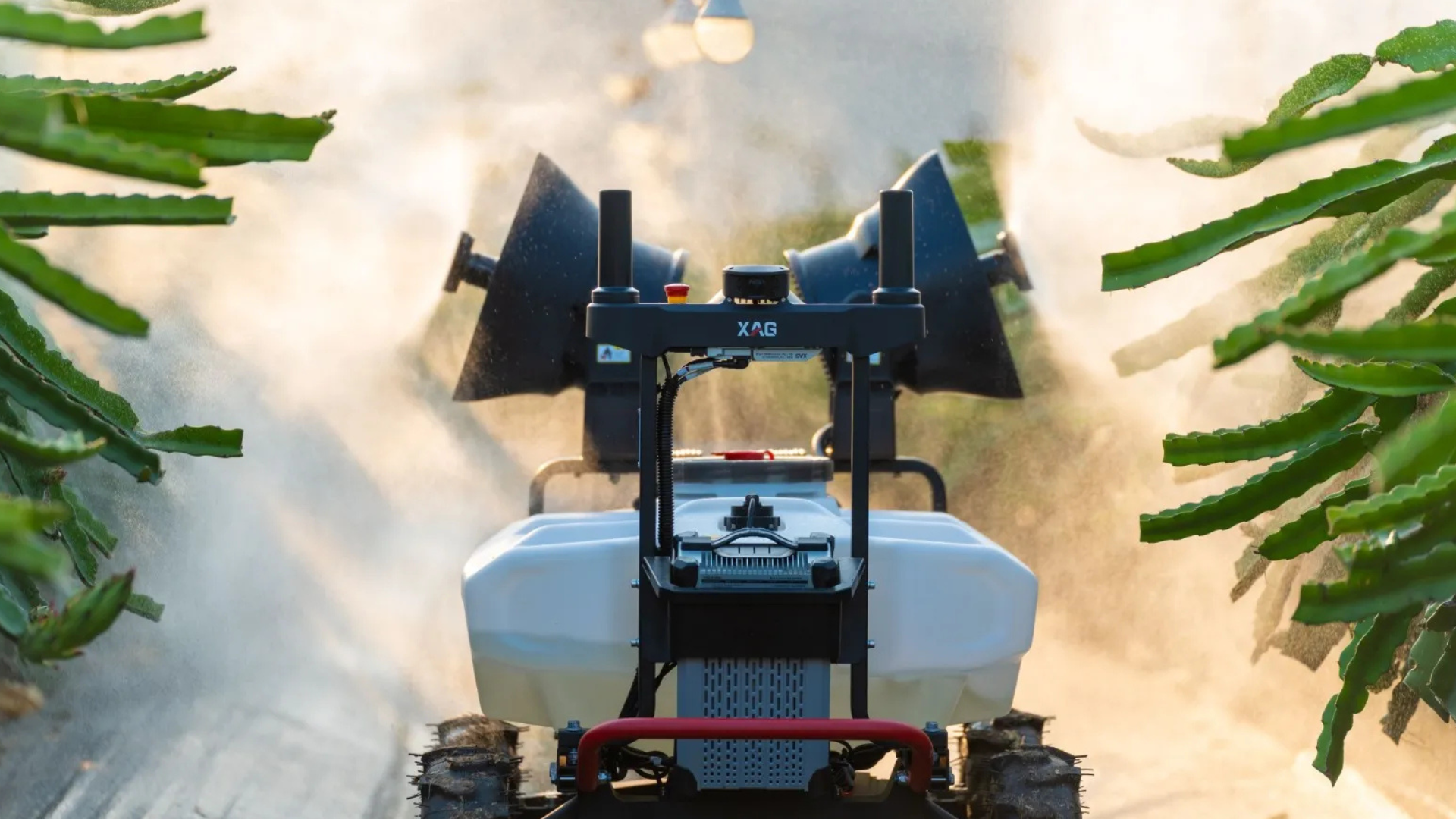
What is the narrow-row challenge in modern orchard management?
High-density apple, pear and cherry orchards are typically planted on rootstocks that keep tree size compact and manageable, with rows spaced to suit platform harvesting and pruning systems. In practice, this often means inter-row widths that leave very little room for machinery. Conventional air-blast sprayers, which are already large pieces of equipment, may be unable to enter the rows at all without risking damage to the trees, the training wires or the irrigation infrastructure that runs through many modern orchards.
The result is that growers either compromise on coverage by spraying from the row ends, accept the limitations of manual application within the rows, or look for an alternative that can actually fit where it needs to go. For fungicide programmes and other ground-applied chemical treatments, this is a practical problem with real consequences for crop protection outcomes.
How does the XAG R100 rover address the narrow-row challenge?
The XAG R100 agricultural rover has a narrow profile that allows it to work comfortably in the inter-row spaces of high-density orchard plantings. Its compact design was developed with exactly this kind of close-canopy horticultural environment in mind, and it navigates the rows autonomously without the risk of damage to trees, wires or infrastructure that comes with larger machinery.
Once the route has been set on the first pass, the rover repeats it accurately on every subsequent run, maintaining its position within the row and delivering consistent coverage throughout. The operator doesn't need to guide it through the rows manually; they monitor progress from outside the planting and intervene only if needed.
Which orchard types benefit most from autonomous rover treatment?
Modern high-density apple and pear orchards are the most obvious candidates, particularly those on Malling or Geneva rootstocks where row widths are tightly managed. Cherry orchards under permanent rain covers present a similar challenge; the cover structure limits the options for aerial application and the inter-row space is often restricted, making autonomous rover treatment a practical solution for ground-based programmes.
Soft fruit cane crops such as raspberries and blackberries, grown in long polytunnel rows across sites in Scotland, Yorkshire and the South East, are equally well suited to rover treatment where the row structure and enclosed growing environment make manual application particularly demanding.
What about older or more traditional orchard layouts?
Traditional orchards with standard or half-standard trees at wider spacings pose fewer access challenges for the rover and, in some respects, are even easier to treat. The rows are wider, the canopy architecture is less uniform, and the variation in tree size and shape that comes with older plantings requires a degree of flexibility in how the application is delivered.
The rover handles this variation well. Its autonomous navigation adjusts to the actual layout of the rows rather than assuming a uniform structure, and its JetSprayer system delivers coverage across a range of canopy heights and densities. For traditional orchards across the West Midlands, the Wye Valley and the older fruit-growing areas of Kent and Sussex, rover treatment is as relevant as it is in the most modern high-density systems.
Can the agricultural drone play a role in narrow-row orchards alongside the rover?
Yes. While the rover handles the ground-based chemical treatment programme, the XAG P100 Pro agricultural drone remains the most practical platform for foliar nutrition and biostimulant applications in orchard settings. Its ability to approach the canopy from above and push product downward through the foliage is particularly useful in high-density plantings where the canopy closes quickly through the season and ground-level coverage of the upper parts of the tree becomes increasingly difficult.
The two platforms work well together across a full-season orchard programme, with each doing the work it is best suited to and neither being asked to compensate for the limitations of the other.
How do I find out whether rover treatment is practical for my orchard layout?
The best starting point is a site assessment. Every orchard is different, and the combination of row width, tree architecture, ground surface and infrastructure varies considerably from one site to another. The QuadRotor team can review your layout and advise on whether the R100 rover is a practical option for your operation and on how a treatment programme would be structured. Get in touch to arrange a conversation or to discuss what a site visit would involve.