
The XAG R100 vs R200: Which Rover Is Right for Your Operation?
If you've been exploring autonomous ground rover technology for your orchard, vineyard or glasshouse operation, you'll have come across two XAG rover options: the R100 and the R200. Both are capable, precise and autonomous; both navigate crop rows independently and deliver consistent ground-based treatment without requiring an operator in the spray zone. The question of which one suits your operation best comes down to a handful of practical factors worth careful consideration before making a decision.
What is the main difference between the XAG R100 and R200 rovers?
The most straightforward way to understand the difference is in capacity and scale. The XAG R100 is the compact, agile option, designed for standard orchard and glasshouse layouts where manoeuvrability and a narrow profile are the priority. The XAG R200 is the heavy-duty workhorse, built for larger operations, longer rows and more demanding terrain where a bigger tank and stronger drive system make a practical difference to how much ground can be covered in a day.
Both rovers share the same core autonomous navigation technology, the same JetSprayer approach to canopy penetration and the same remote controller system. The differences lie in the machine's physical scale and the operational capacity it entails.
Which operations are best suited to the XAG R100 rover?
The R100 is the right choice for operations where access and manoeuvrability are the primary considerations. Its compact profile makes it well suited to high-density orchard plantings where row widths are tight, standard commercial glasshouse layouts where the growing rows leave limited space for equipment and smaller vineyard sites where the inter-row spacing is manageable but still too narrow for conventional tractor-mounted machinery.
Its four-wheel-drive system handles the gentle gradients and moderately uneven surfaces found across many English orchard and vineyard sites, and its endurance on a single battery charge is well suited to the row lengths typical of these environments. For operations that require a rover to access areas larger equipment cannot reach, the R100 is the more practical option.
The R100 is also a sensible starting point for operations new to autonomous rover technology, who want to introduce it progressively into their crop protection programme before committing to a larger platform.
Which operations are best suited to the XAG R200 rover?
The R200 comes into its own on larger, more demanding sites. Its significantly larger tank means fewer refill stops during a treatment run, which matters in vineyards or orchards with long rows where interrupting the application to refill adds time and disruption to the programme. Six-wheel drive gives it the traction to handle steeper gradients and more challenging ground conditions than the R100 is designed for, making it the better choice for vineyard sites on more pronounced slopes or orchards with uneven, rutted inter-row surfaces.
For large commercial glasshouse operations covering significant areas under glass, the R200's greater capacity means it can cover more ground between refills, reducing interruptions to the programme and improving the overall efficiency of the treatment session.
Operations with extensive treatment programmes running through the season, where the cumulative hours of rover operation are high, will also appreciate the R200's robust construction and the endurance that comes with a heavy-duty platform built for sustained use.
Can the R100 and R200 rovers be used on the same site?
Yes, and for larger or more complex operations, there can be a practical case for deploying both. A large vineyard, for example, might use the R200 for the main fungicide programme across the principal blocks while the R100 handles treatment in a section of the site with tighter row spacings or more restricted access. The two rovers share the same control system and navigation platform, so operating both within the same programme is straightforward.
For most individual operations, however, one rover will be the right fit, and the choice between them comes down to the specific characteristics of the site and the treatment programme rather than a need for both simultaneously.
How do both rovers handle canopy penetration compared to conventional equipment?
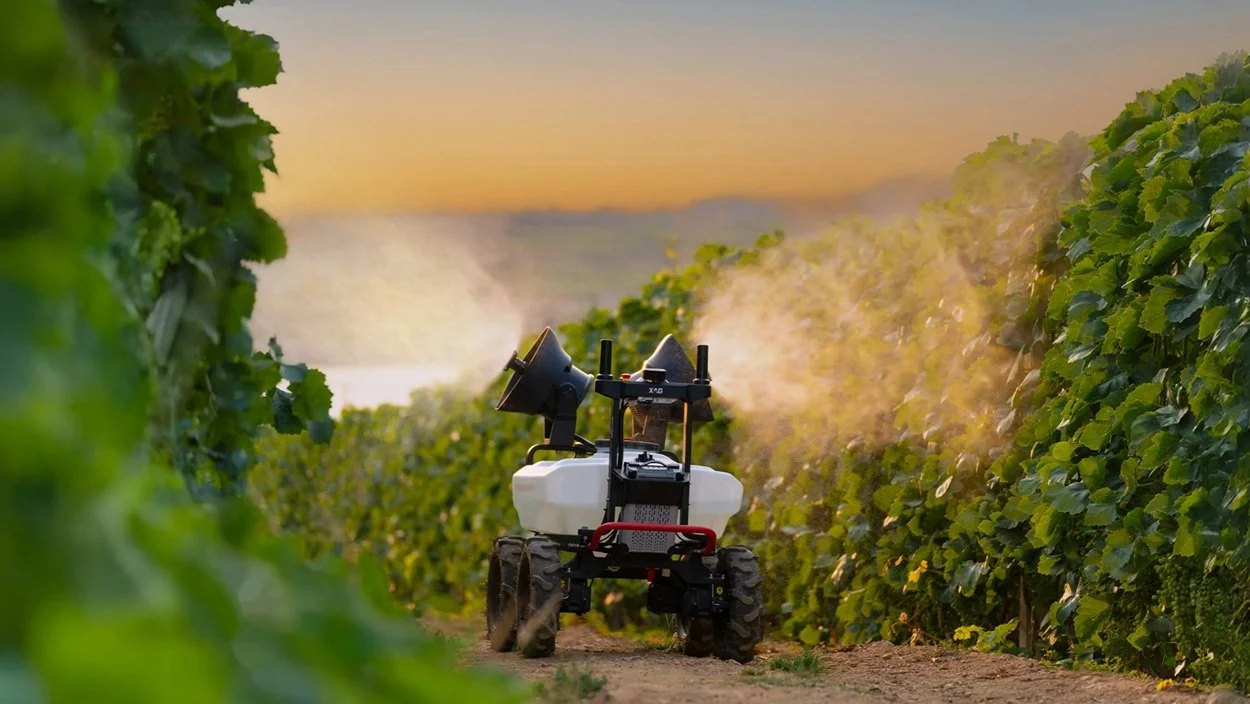
Both the R100 and R200 use the same JetSprayer system to achieve canopy penetration, generating directed airflow that drives the spray laterally into the crop from the row side. The R100 carries two JetSprayers, and the R200 carries four, giving the larger rover greater coverage width and output per pass. Both achieve the kind of thorough coverage on both surfaces of the foliage and into the bunch zone or inner canopy that is difficult to replicate consistently with a hand lance or conventional air-blast sprayer.
For fungicide programmes, herbicide applications and other ground-based chemical treatments that must be delivered via rover rather than drone under current UK rules, both platforms deliver consistent, repeatable results that manual methods struggle to match across a full treatment session.
What role does the agricultural drone play alongside either rover?
Whichever rover suits your operation, the XAG P100 Pro agricultural drone remains the appropriate platform for the aerial applications that complement the rover's ground-based programme. Foliar nutrition, biostimulants, plant growth regulators and aerial seeding are all well suited to drone delivery, and the two platforms work well together as part of a coordinated crop management programme across the season.
The rover and the drone are not competing options; they cover different parts of the same programme, and the combination of both gives an operation considerably more flexibility than either platform alone.
How do I decide which rover is right for my site?
The most useful starting point is a conversation with the QuadRotor team about your site, your crop type and the treatment programme you need to run. Row widths, terrain gradient, the length of your treatment runs and the overall scale of the operation all influence which rover is the better fit, and in some cases, a site visit is the most practical way to assess the options properly. Get in touch with the QuadRotor team, and we'll help you work through the decision.