
Commercial glasshouse growing in the UK operates at a scale that makes many traditional maintenance tasks genuinely difficult to execute well. A single nursery complex in Lincolnshire, the Lea Valley or West Yorkshire might cover tens of hectares under glass; roof areas that would take a manual team days to treat properly, even with the right access equipment. Whitewashing (the seasonal application of shading compounds to regulate internal temperature and light) is one such task. QuadRotor's greenhouse shading service brings drone application to that challenge; making what was once a slow, labour-intensive job into something that can be planned, executed and completed within a tight operational window.
What Is Polytunnel and Glasshouse Whitewashing?
Whitewashing refers to the application of a light-diffusing compound to the exterior surface of a glasshouse or polytunnel roof. The product reduces solar intensity inside the structure during the high-irradiance months (typically May through to September in the UK), protecting crops from heat stress whilst allowing sufficient diffuse light to pass through for productive growth.
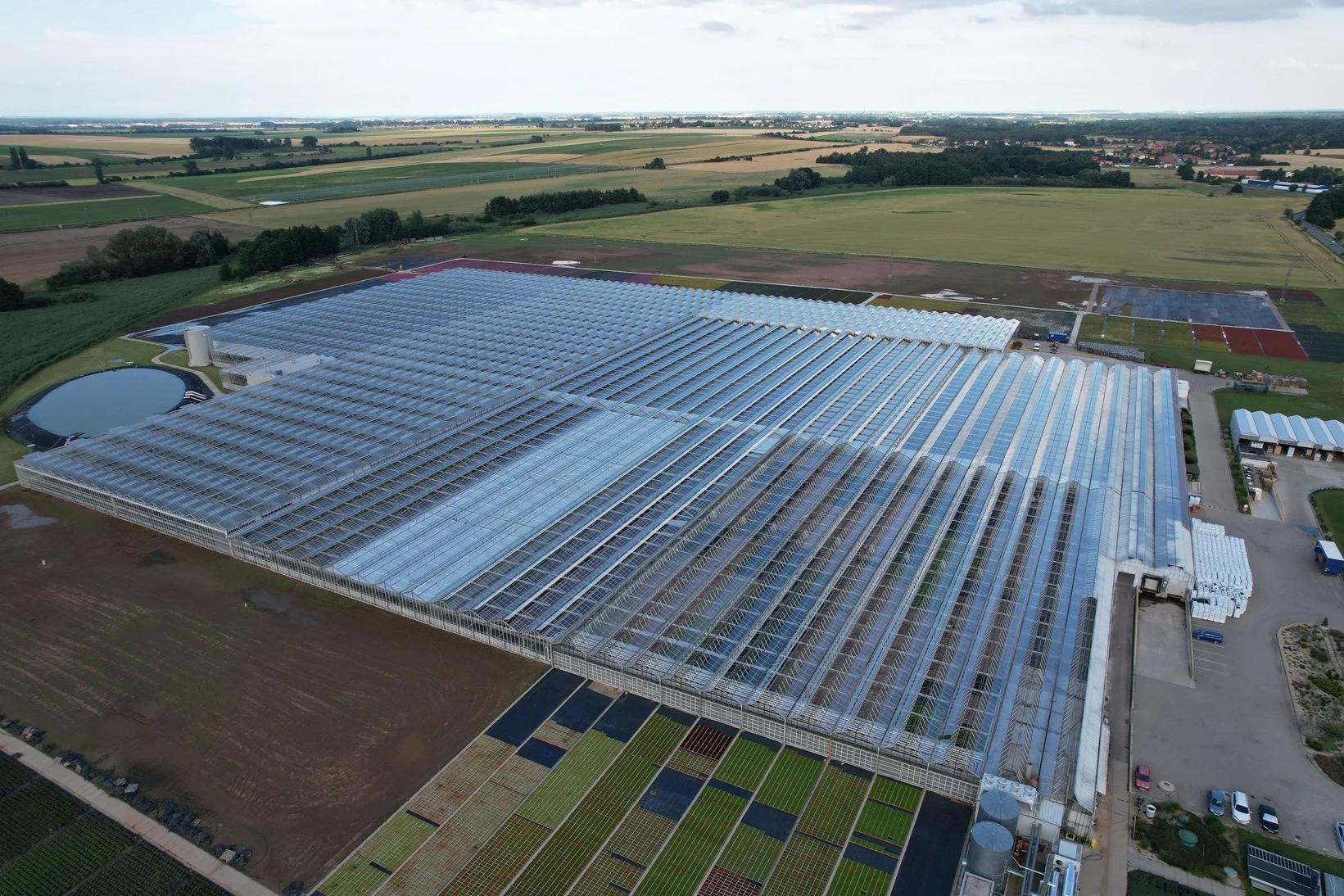
It's a well-established technique in commercial protected cropping; standard practice across large nursery operations growing tomatoes, cucumbers, peppers, pot plants, and soft fruit under glass. The chemistry of the products has evolved considerably (modern formulations are more controllable, more uniform and easier to remove at season's end than older lime-based compounds), but the fundamental principle remains the same.
Why Is Scale Such a Challenge With Traditional Application Methods?
For a small tunnel, manual application is manageable. For a multi-bay glasshouse complex spanning several hectares, it becomes a significant logistical undertaking. Access equipment (cherry pickers, elevated work platforms, or roof-mounted trolley systems) is expensive to hire, slow to move around a large site, and introduces safety considerations around working at height that require careful management.
Manual spray teams covering large roof areas also struggle to maintain consistent product thickness across the entire surface. Variation in coverage (heavier in some areas, thinner in others) produces uneven shading inside the structure, creating hotspots and inconsistent crop development that a grower then has to manage for the rest of the season.
How Does Drone Application Solve the Scale Problem?
A drone covers roof area at a speed and consistency that ground-based equipment simply cannot match. Flight paths are pre-programmed using RTK GPS, meaning the aircraft follows a precise, systematic route across the entire roof surface at a fixed height and speed. Product output is controlled throughout, resulting in an even, consistent coating across the full application area, including sections of the roof that would be among the most difficult to reach with conventional methods.
For large commercial nursery operations, this translates into a job that might previously have taken several days of manual work being completed in a fraction of that time; without scaffolding, without elevated platforms, and without the associated health and safety complexity that comes with putting staff on or near a glasshouse roof.
Does Drone-Applied Whitewashing Produce a Consistent Finish?
Consistency is one of the strongest arguments for drone application at scale. Because the flight path, height, speed, and output rate are all set in advance and maintained autonomously throughout the operation, the finished result is uniform, making it very difficult to replicate with manual application over a large area. There's no variation caused by operator fatigue, overlapping passes, or sections of the roof that were harder to reach than others.
For nursery operations where crop uniformity is commercially important (large-scale pot plant production or propagation, for example), consistent shading across the full growing area is more than a maintenance preference; it directly influences the quality and consistency of what comes out at the other end.
Is Drone Whitewashing Suitable for All Glasshouse Types?
Most large commercial glasshouse configurations (Venlo-style glass, wide-span steel and polythene structures, and multi-bay tunnel complexes) are well suited to drone application. Site-specific factors, such as proximity to other structures, overhead cables, or restricted airspace, may influence how an operation is planned; a site assessment before the first application is always the most reliable starting point.
QuadRotor works with growers across the UK to assess each site individually, plan the most effective flight approach, and ensure the application is timed to align with the forecast and the crop's specific requirements at that point in the season. It's commercial nursery automation applied to one of the most fundamental tasks in protected cropping.